

Most fraud and dispute teams track write-offs. Fewer track true losses. Almost none track recapture, and that gap is costing financial institutions real money. Here’s what each term actually means, how they connect, and what your institution should be measuring instead.
What is a write-off in dispute management?
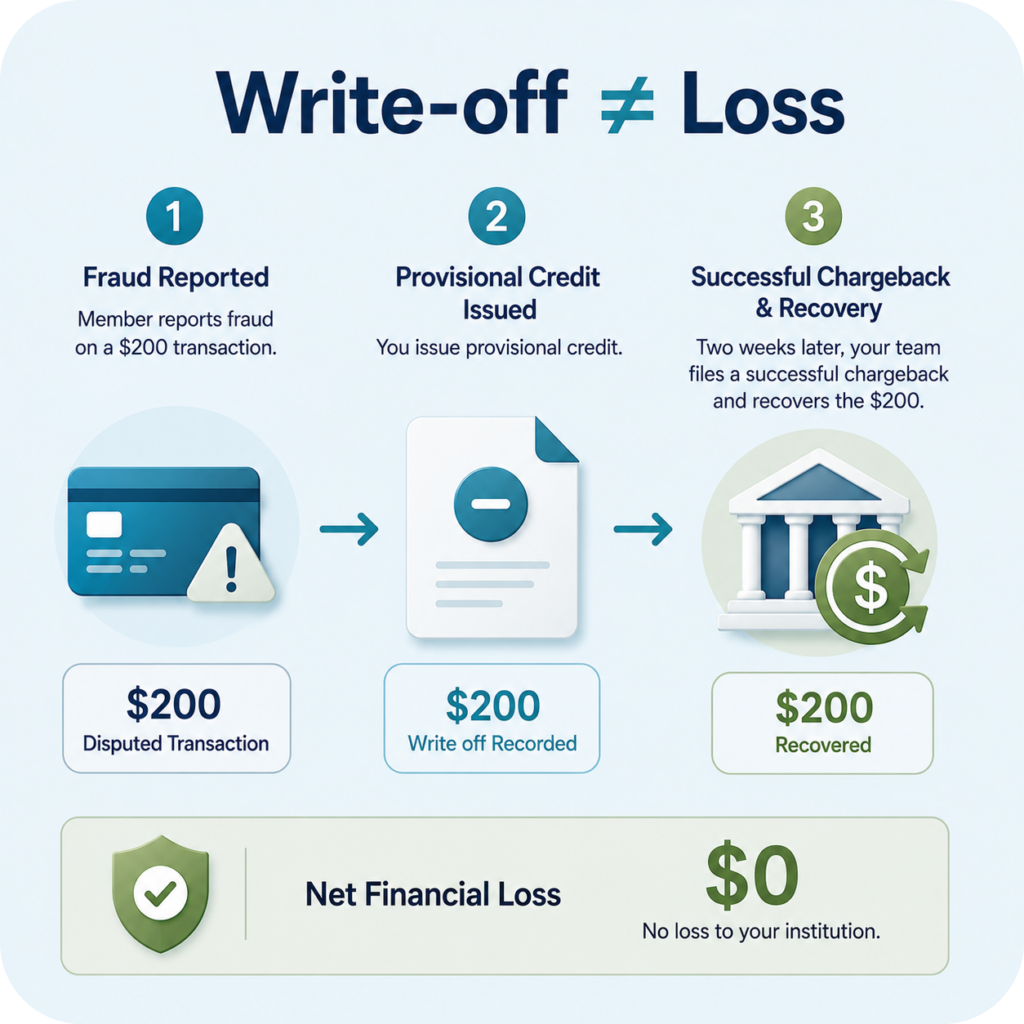
A write-off is an accounting event. It records that a provisional credit was issued to a cardholder. It does not mean the institution has permanently lost those funds.
Example: a member reports fraud on a $200 transaction. You issue provisional credit. That’s a write-off. Two weeks later, your team files a successful chargeback and recovers the $200. The write-off stays on the books, but your net financial loss is zero.
This is why write-off totals, in isolation, are a misleading measure of operational performance.
What is a true loss?
A loss is a financial loss resulting from disputed funds that left the institution and remained unrecovered. It reflects what actually hit your bottom line after all recovery and denial activity is complete.
Write-offs measure accounting volume. Losses measure financial impact. The two are related but not the same, and conflating them leads to bad operational decisions.
What is recapture rate and why should you track it?
Recapture is a metric developed by Quavo to reflect the true inverse of loss. It measures the percentage of disputed dollars that could have resulted in a loss but didn’t, either because funds were recovered (via chargeback or merchant collaboration) or because the claim was appropriately denied.
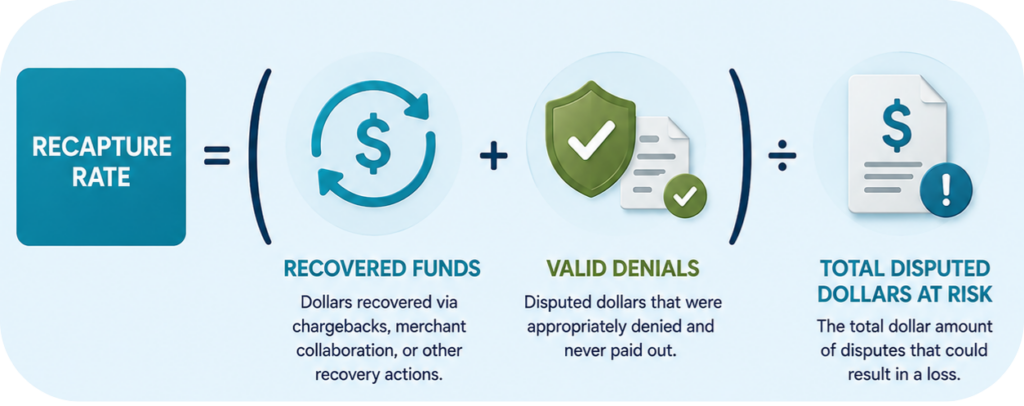
It’s a more honest measure of how well your dispute operation is actually performing. Loss rate tells you what went wrong. Recapture rate tells you how much you’re getting right.
What does a good recapture rate look like?
Based on Quavo’s data across hundreds of issuing financial institutions:
- Industry average (outside Quavo clients): ~74% recapture
- Quavo client average: ~82% recapture
- Top-performing Quavo clients: up to 97% recapture
That 8-point gap between industry average and Quavo client average represents real dollars. For an institution processing $10M in disputed funds annually, moving from 74% to 82% recapture means recovering $800k that would otherwise become a net loss.
Why do so many institutions have low recapture rates?
Three patterns show up repeatedly across the industry:
- Fast credit, slow recovery. Most institutions are quick to issue provisional credit but slow to pursue chargeback and recovery. Deadlines get missed, dollars get left on the table.
- Siloed operations with no real-time visibility. Fraud and dispute teams often lack the reporting to know how they’re performing until month-end, by which time recovery windows have closed.
- Missed denial opportunities. Not every claim deserves a payout. Without automation to flag clear-cut denials, like a merchant refund already posted or an authorization that never settled, teams over-credit and under-deny.
How does automation improve recapture rate?
Automation addresses all three failure points above. Specifically:
- Automated investigation workflows ensure recovery actions are initiated immediately and deadlines are never missed.
- Real-time dashboards give operations leaders visibility into recapture performance as it happens. Intelligent denial logic flags simple cases, including merchant refunds, authorization reversals, duplicate claims automatically.
- Merchant collaboration integrations (Verifi, Ethoca) accelerate recovery on eligible disputes before they escalate to chargebacks.
Quavo’s QFD® platform automates up to 90% of dispute processing tasks, enabling institutions to resolve cases 26 days faster than the industry average — and recover significantly more of the dollars at risk.
What should your institution do next?
Start by separating your write-off and loss reporting. If you’re currently using write-off totals as a proxy for financial performance, you’re likely underestimating both your losses and your recovery opportunity.
Then calculate your recapture rate. Add your recovered funds and valid denials, divide by total disputed dollars at risk, and benchmark against the figures above.
If your recapture rate is below 80%, the gap is almost always driven by manual processes, limited visibility, or both, and it’s addressable.