

Dispute data from Quavo reveals a surge in gas-station fraud tied directly to rising prices, revealing a growing pattern that issuers can no longer afford to treat as background noise.
Fuel disputes are having a moment and it’s not a good one.
Across Quavo’s client base, dispute volume tied to gas-station transactions (MCC 5541 and 5542) hit a 16-month high in April 2026, running 30% above the 2025 monthly average. But the volume story is only half of it. The cost of each dispute is climbing, too, up 28% from the 2025 baseline to $40. Taken together, rising dispute volume and higher average amounts point to growing financial risk for issuers.
Q2 2026’s run rate tells the clearest version of the story: 128,000 disputes projected, $4.9 million in total dispute dollars, and a national average gas price of $3.98 per gallon. For context, Q1 2025 (the baseline) was 94,000 disputes at $3.2 million with gas at $3.10. That’s a 36% increase in volume and a 53% increase in total dollars in just over a year.
Fuel Dispute Data
Data sourced across Quavo’s 50+ issuer and technology company client base for MCC 5541 and 5542 transactions.
Dispute volume & amount growth
Q1 2025 vs. Q2 2026 (projected)
* Q2 2026 figures are projected estimates.
What’s Driving Fuel Fraud
The data points to four distinct patterns, each with its own fingerprint.
Card testing at the pump.
Unattended fuel pumps have long been a testing ground for stolen card credentials. Fraudsters run small, round-dollar transactions to confirm a card is live before using it elsewhere. The data makes this unmistakable: $10 is the single most common dispute amount in the dataset, with 24,445 occurrences.
Bladder filling and resale fraud.
Organized rings are using stolen cards to fill portable fuel containers, then reselling the gas at a discount. Higher gas prices make this scheme more profitable per transaction.
Pump maxxing.
Fraudsters repeatedly hit pump transaction limits to extract the maximum value from each stolen card before it’s shut down. The data shows loss concentrations at specific dollar amounts: $150 appears in roughly 2,000 loss occurrences, and $175 in about 1,400. These clusters necessitate transaction-level monitoring at those thresholds. Quavo recommends strategy development on authorization advice messages to effectively capture these events.
Consumer price-relief disputes.
Not everything in the data is fraud. A portion of it includes cardholders who are under financial pressure and using the dispute channel to challenge legitimate charges as gas prices climb. This affects dispute outcomes, adds volume to queues, and requires a different resolution approach than outright fraud. The 28% increase in average dispute amount (now at $40) reflects both third and first-party fraud.
Why Fraud Leaders Need to Pay Attention
The correlation between gas prices and dispute activity isn’t by happenstance. Q4 2025, when national average gas prices dipped to $3.00 per gallon, was the only quarter with a volume decline (-9% QoQ). As prices recovered and then moved higher into 2026, disputes followed trend. The higher prices increase the incentive for fuel resale fraud, raise the stakes for card testing, and push more consumers toward filing claims for financial relief.
With gas averaging $3.98 nationally, the current Q2 2026 run rate suggests the pressure isn’t letting up. If prices hold or rise further, so does dispute exposure.
For issuers and card program managers, the operational implication is direct. The round-dollar clustering at $10 and $20 indicates fraud schemes actively running. The $150 and $175 loss concentrations are addressable with targeted detection rules. And the rising average dispute amount means every approved claim carries more financial weight than it did a year ago.
Fuel disputes aren’t a niche category anymore. At a 16-month high in volume and with average dispute costs up more than a quarter year-over-year, they’re a meaningful driver of dispute program exposure, moving with an external variable (gas prices) that shows no sign of stabilizing.
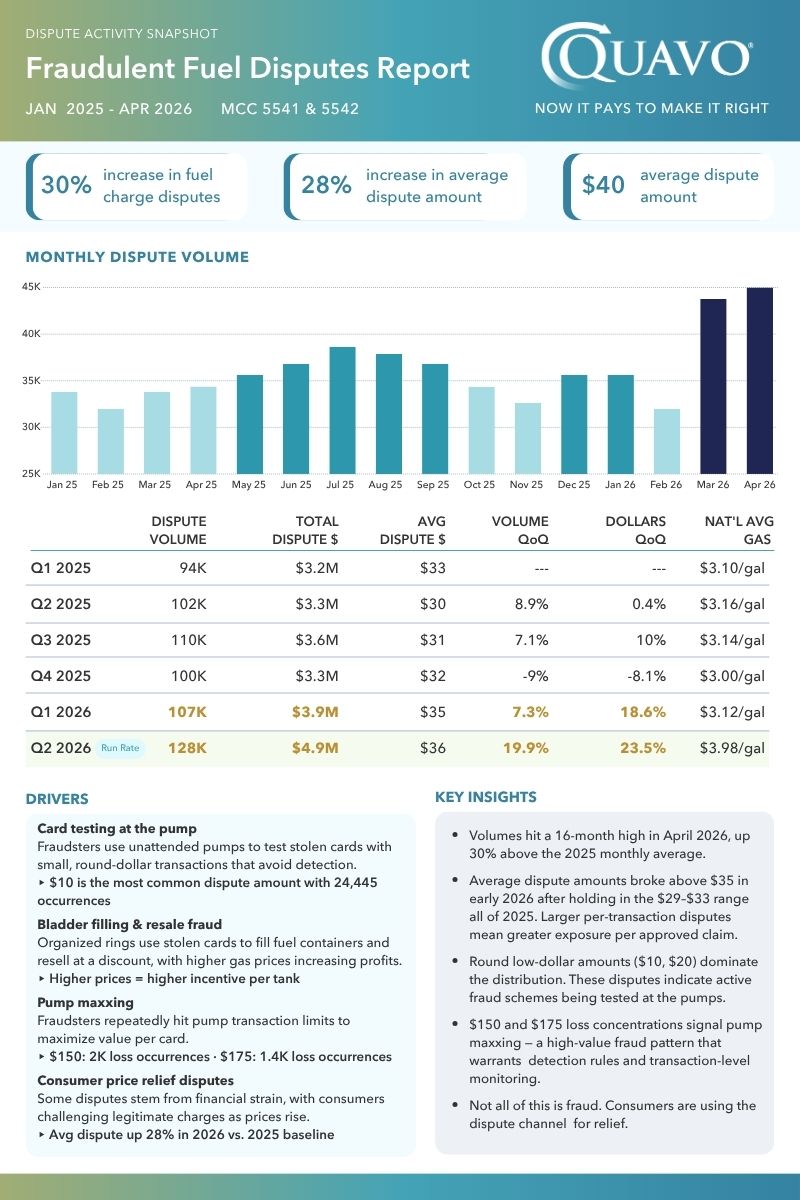
Data sourced from Quavo dispute activity across MCC 5541 (gas stations) and MCC 5542 (automated fuel dispensers), January 2025 through April 2026.