
Every fraud wave has a tell: a merchant category code that starts showing up too often, a filing pattern that doesn’t fit the usual profile, or a data point that makes your fraud team lean forward and say: that’s not a coincidence.
AI subscription fraud is that tell right now.
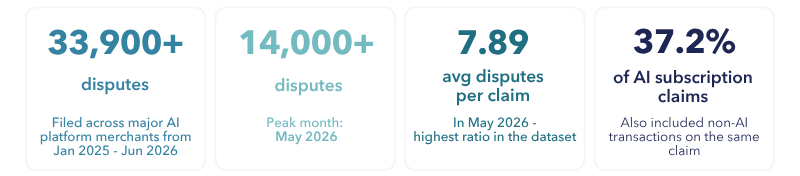
Between January 2025 and June 2026, Quavo recorded nearly 34,000 disputes tied to major AI platforms. Volume climbed steadily through 2025, then accelerated sharply in early 2026 — peaking at more than 14,000 disputes in May 2026 alone. The average disputes-per-claim ratio nearly doubled month over month heading into that peak.
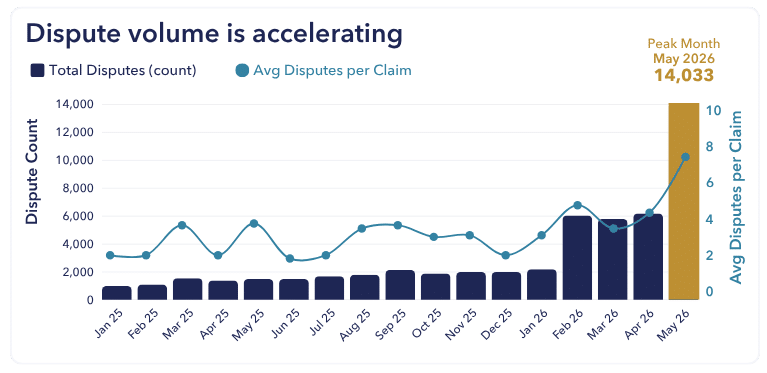
This isn’t confused cardholders forgetting a subscription. This is organized fraud building an infrastructure, and they’re using you to fund it.
Fraudsters Aren’t Just Stealing AI Subscriptions. They’re Using Them.
The first question your team will ask is the right one: why would fraudsters want an AI subscription?
The answer is that AI tools have become an operational infrastructure for modern fraud. It’s the same as a fraudster in a previous era needing a burner phone and a mail drop. Today, they need a subscription.
Social engineering that actually works. The era of catching phishing by bad grammar is over. A fraudster with access to a large language model can produce personalized, professional-grade lures at volume, meaning that emails, SMS campaigns, and voice scripts will all pass the sniff test. The barrier to professional-grade social engineering has essentially been eliminated.
Synthetic identities that hold up. AI tools can generate consistent backstories, produce supporting documentation, and fill out applications coherently with the ability to refine personas over time. First-party fraud and new account opening schemes are getting harder to detect at the front door precisely because the identity being used was built with better tools than the ones checking it.
Deepfakes and voice cloning hitting verification. Multimodal AI platforms now produce audio and image output at a quality that defeats basic verification checks. These capabilities are showing up in wire transfer authorization scams, CEO fraud, and KYC bypass, which are all vectors that convert directly into dispute exposure and potential regulatory scrutiny.
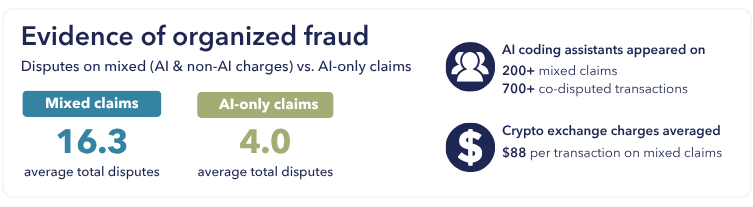
Automated fraud tooling, no developer required. What previously required a skilled developer can now be assembled with natural language prompts. One AI coding assistant appeared on over 200 mixed claims in Quavo’s dataset, with more than 700 co-disputed transactions. Its presence alongside other AI subscriptions is a strong signal: this isn’t a single bad actor with one tool. It’s someone building a stack.
The Co-Disputed Merchants Tell the Real Story
Here’s where the data gets specific in a way that matters.
37.2% of AI subscription claims in Quavo’s dataset also include non-AI transactions disputed on the same claim. The average disputed transaction count on those mixed claims was 16.3, compared to 4.0 for AI-only claims. That gap means the difference between a compromised card and a compromised operation.
Two co-disputed merchant categories stood out beyond everyday digital services:
An encrypted messaging platform and a major cryptocurrency exchange both appeared on mixed claims alongside AI subscriptions. The messaging platform is widely used as a fraud coordination channel. The crypto exchange charges averaged $88 per transaction. The pattern is clear: AI for content and identity generation, encrypted messaging for coordination, crypto for liquidation. The dispute data is the exhaust trail of organized fraud infrastructure, and it’s running through card portfolios whether the issuer can see it or not.
The Structural Problem: You Can Only See Your Own Data
Your data shows you what’s happening in your book. It can’t show you what’s coming across everyone else’s.
The signals that predict emerging fraud vectors don’t always reveal themselves within one institution’s book of business. Patterns that take months to identify overwhelmingly hit overnight. They appear in aggregate, across issuers, before they become systemic in any one portfolio. The patterns that seem to hit overnight have often been building in the network for weeks, and the institutions with cross-issuer visibility have a warning window. The ones watching only their own data have no choice but to be reactive.
This is what having experience on your side means in practice. Quavo’s dispute network processes more than one million disputes monthly across banks, credit unions, fintechs, and processors of every size. At that volume, emerging fraud patterns become visible in the aggregate data well before they register as anomalies in any single portfolio. A cardholder who has filed the same dispute type across four institutions in 90 days looks like a legitimate claimant to each institution individually. Across the network, that behavior is unambiguous.
No issuer builds that vantage point alone. It only exists at network scale.
Compliance Is Where It Gets Expensive
AI-powered fraud complicates compliance in a specific and costly way: it generates disputes that look like noise when viewed individually, but reveal as a systemic pattern when viewed across a portfolio. Institutions that can identify that pattern early can address it proactively. Institutions that can’t are reactive, and that means slower resolution, higher write-offs, and the kind of pattern a regulator notices.
Getting compliance working for you means having the intelligence infrastructure to see systemic exposure before it becomes a regulatory flag, a sponsor bank conversation, or a cardholder trust problem. Cross-issuer data is a meaningful part of that build. It surfaces the signal that individual portfolio data buries in noise.
What Good Looks Like
The institutions getting ahead of AI-powered fraud aren’t doing it with a single control. They’re layering intelligence across the full transaction lifecycle:
Cross-issuer intelligence as an early warning system. Emerging fraud motion appears in aggregate data before it’s visible in any single portfolio. When a new dispute pattern crosses a threshold in Quavo’s network, connected institutions have days or weeks to adjust strategy before the volume hits their own books. That lead time is the difference between a managed response and a reactive one.
Authorization-stage intervention. AI subscription charges are predictable in their patterns: low dollar amounts, recurring cadence, digital merchant categories. Monitoring that flags unusual clusters of these, especially when combined with crypto exchanges or P2P transfer platforms. Intervene before a chargeback is filed because resolution after the fact is always more expensive.
Account-level velocity controls. High disputes-per-claim ratios correlate strongly with broader account compromise. Accounts accumulating multiple AI subscription charges within a single billing cycle warrant review, and those controls can be calibrated to contain exposure without disrupting legitimate cardholders.
Portfolio-wide merchant profiling. The full picture only becomes visible when dispute activity is aggregated across the entire book of business. That portfolio-wide view reveals patterns that are invisible at the account level and builds the evidence record for effective chargeback filing.
The Bigger Picture
The fraud landscape is being professionalized, automated, and scaled by the same tools reshaping every other industry. Fraudsters acquiring AI subscriptions aren’t confused about what they signed up for. They’re making a business investment, and the return comes out of recovery dollars left on the table, resolution cycles that run too long, and compliance exposure that compounds.
Disputes are a trust moment, a compliance risk point, and a recoverable revenue opportunity. And when you have the right intelligence, they’re a window into what’s coming next.
Quavo Fraud & Disputes | quavo.com | Data sourced from QFD production environment, Jan 2025–Jun 2026