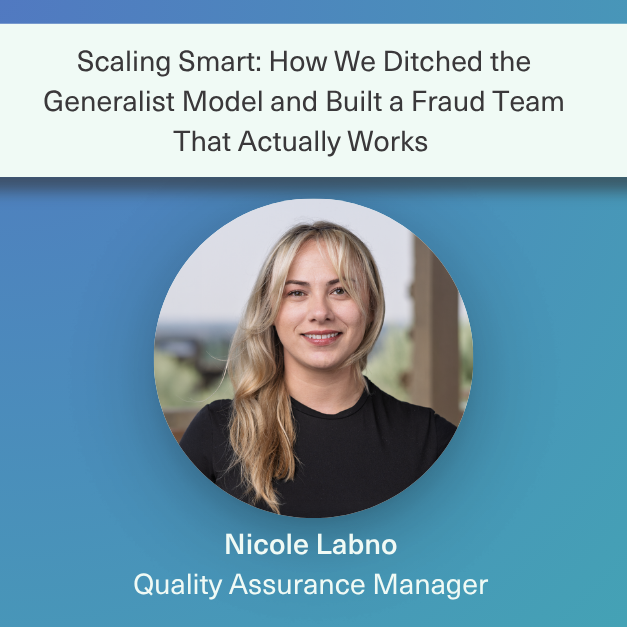

When your business is growing fast, it’s tempting to think the solution to every operational challenge is simple: hire more people. But what we learned at Quavo is that scaling isn’t just about adding headcount. It’s about fundamentally rethinking how your team operates.
Scaling Business Kickstarted Workforce Shifts
In the early days when our portfolio was tight, we operated with a team of generalists. Everyone worked every assignment, pivoting between queues on the fly. This approach gave us maximum agility and flexibility, and frankly, it worked beautifully when volumes were low.
But as Quavo scaled and our client count skyrocketed, the cracks began to show. Our investigators were stuck in growing queues, never feeling like they could catch up. We were maintaining healthy volumes on paper, but the effort required from our team was unsustainable. Racing against the clock in a highly regulated industry doesn’t just feel bad, it’s also risky.
We knew we needed a shift in philosophy. Instead of asking our team to be everywhere at once, we focused on getting the right people in the right place at the right time, doing the right kind of work. We took a 360-degree approach to identifying the core issue while keeping our people-focused values front and center.
This meant digging into the data to see what was lagging, which tasks were consuming the most resources, and how we could better support our team. But data alone wasn’t enough. We sat down with our investigators to hear their real-world testimonies and gather their insights. This collaboration delivered our light bulb moment: flexibility at scale is not as important as meeting SLAs. We had to abandon the generalist approach and reorient our team into specialists. But that was only part of the solution.
Creating Capacity for Health Checks
With our new specialist model taking shape, we created an analyst role and built a new client-facing team for senior investigators who possessed the experience and research abilities to push for real impact. These team members could identify operational opportunities, spot gaps, and communicate effectively with clients.
The team’s focus became environment health, identifying aged dispute segments and ensuring the most pressing work was prioritized to maintain stability. This shift allowed us to be more proactive with volume health and client consultation rather than constantly playing catch-up. The team can now accurately predict capacity needs as new clients onboard, resulting in a finely-tuned workforce built to scale.
Takeaways for Fraud & Dispute Managers
The biggest lesson we learned is that not every problem is solved with more bodies. That’s a band-aid fix. Instinct says more disputes equal more FTEs, but you’re actually increasing the risk of poor quality decisions, which can fracture accountholder trust and impact compliance adherence.
Another critical lesson involves data. It’s often positioned as every manager’s north star, but here’s the truth: data only goes so far. It’s an interpretational timestamp that doesn’t tell the full story. What managers really need is experience. The ability to analyze data and trace outcomes back to root causes is a learned skill, and it takes time to develop.
The most important takeaway is this: develop your people and the results will come. When your team sees value in what they do, they’re more invested in the outcomes of their work. That investment translates directly into higher quality and lower churn, which are the metrics that actually matter when you’re building something meant to last.
At Quavo, we built our platform around exactly this philosophy — because when your people are supported by intelligent automation, the results follow. Industry leaders rely on us to process 1M+ disputes every month, resolve cases 26 days faster, and recapture 80%+ of disputed dollars. Now it pays to make it right.