

Over the past three years, major streaming services have repeatedly raised prices between June and October, making late summer and early fall a common window for subscription hikes. Quavo’s analysis of streaming service disputes found that a routine chargeback may not be as likely to win as it once was.
The shift stood out because, in one group of streaming brands we track, issuers had won 92% to 96% of disputes for eleven straight months before the win rate fell to 58% in July.
The 35-point drop in issuer wins was significant enough to warrant a closer look.
Why issuer losses are spiking on subscription chargebacks
Nothing about the incoming disputes had meaningfully changed. Resolved dispute volume was essentially flat, up about 10% from one 30-day window to the next.
Looking at the outcomes over the same period, issuer losses rose more than 1,000%, an elevenfold increase in under a month, climbing every single day.
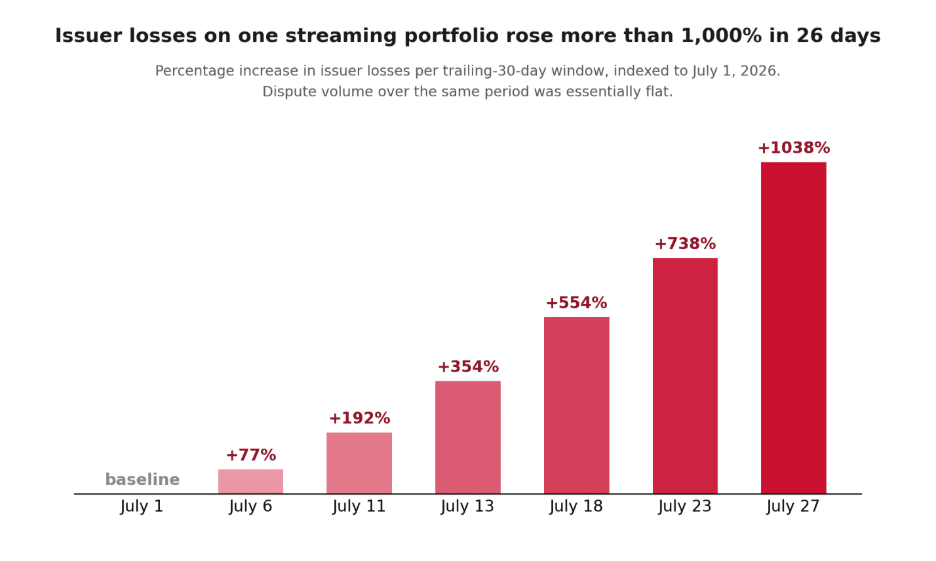
Growth in issuer losses on one streaming portfolio, indexed to the July 1 trailing-30-day window. Dispute volume over the same period was essentially flat.
Two things told us this was a deliberate merchant decision rather than random drift.
Related brands moved together. Large streaming companies do not run one account in the payment data. They run many, often several per brand. Across a group of sibling brands under shared ownership, every account flipped inside the same three-week window: one fell from near-total issuer wins to between 52% and 65%, another from 98% to 60%, a third from 89% to 44%. Separate teams do not usually change course all at once. When they do, it is a strong sign that something changed higher up.
The drop was concentrated, not evenly spread. Across the wider digital subscription category, issuer win rates stayed relatively consistent, drifting only from 28% to 25% over the same period. That makes an industry-wide rule change unlikely and points instead to a company-level shift in dispute strategy. And that is exactly why this matters: if one streaming parent can make this change, others are positioned to do the same.
Why streaming providers are changing dispute strategies now
Streaming disputes can be easier for merchants to fight than many other types of claims. Many involve first-party fraud or auto-renewal complaints, where the customer did sign up for the service but later disputes the charge. Those are defensible with account records, device history, viewing activity and clear terms, and streaming companies have all four in their own systems. Three factors may have helped drive the shift.
Terms and platforms are consolidating. Streaming parents have spent two years merging sibling brands onto shared billing and a single subscriber agreement, usually with explicit new language on auto-renewal, free trials, cancellation timing and refunds. Once that is done, one operational change reaches every brand on the same day.
Losing got more expensive. Card network dispute-ratio thresholds tightened in April 2026, and merchants that exceed those limits now pay a fee for each dispute. Waving cases through is no longer the cheap option.
The economics flipped. Providers that spent years chasing subscriber growth at any cost are now reporting quarterly profits and running hard at churn. Revenue defense is a priority, and every dispute puts revenue at risk.
Merchants have more reason to fight disputes than ever, and it has never been easier to do it at scale. We expect to see more of this, not less.
How do chargebacks get initiated
When a cardholder finds a transaction they don’t recognize or believe they shouldn’t have to pay, they dispute it with their bank. The bank pulls the money back from the merchant, and the merchant can fight the chargeback by providing evidence, like login history, device information, or the terms the customer agreed to. If that evidence holds up, the merchant gets the money back and the issuer takes the loss.
How issuers can adjust to changing merchant chargeback strategies
Adjust your recovery expectations. Any recovery model, provisional credit policy or work-queue rule built on a 90%-plus win rate against streaming merchants is now roughly 35 points out of date. The full impact has not yet shown up in the thirty-day window, which means issuer win rates could fall below 58%.
Front-load the claim. Once a well-documented merchant rebuttal lands, the argument is largely over. The leverage sits at intake: capture the cancellation date and how the customer cancelled, prior account usage, and whether the login was shared across a household. Re-screen thin card-absent fraud claims before the chargeback goes out.
A narrow view will miss the signal. Viewed one by one, these looked like eight small anomalies. Grouped under the parent company, they became one obvious shift. Most issuer reporting stops at the individual merchant account. That means the next big signal may look small until you connect the brands, merchants, and behavior behind it.
No single bank or credit union can see the full dispute picture alone
An issuer looking only at its own streaming disputes this summer would have reached for the usual explanations: our evidence quality slipped, a rule changed, friendly fraud is rising.
None of those were true. To see what was really happening, you had to connect the dots across multiple merchant accounts, several brands, one parent company, and the broader category, across multiple institutions. That view does not exist inside any one portfolio.
A broader view gives your institution the clearest and most accurate indicators to guide its decision making. Our solutions draw on more than 25 million disputes a year across 650+ issuers and brands, with data anonymized and reported in aggregate. That scale helps us spot shifts that would be easy to miss inside a single portfolio, then turn those signals into something institutions can act on, from recovery strategy to case routing and intake.
Merchants are getting better at fighting disputes, and they can change strategy fast. If issuers are still relying on quarterly benchmarks, they may not see the shift until months later, after the losses have already piled up.