
Dispute volume doesn’t wait for your staffing plan. For a credit union with a lean back office, a few departures or a spike in card fraud can quickly put regulatory deadlines at risk. For a fintech launching a card program, disputes can start coming in before the team has the expertise to handle them.
Outsourcing makes sense, but not all providers deliver the same level of service. Plenty can process claims, but not many take ownership of the outcomes.
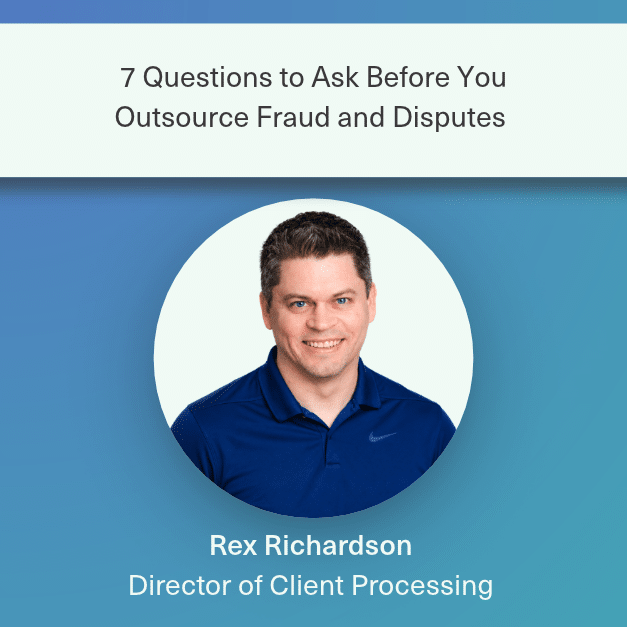
I lead the Dispute Resolution Experts (DRE) team, and these are the seven questions I’d ask any provider before signing a contract.
- Who’s actually working our claims, and what experience do they have?
This is probably the most important question and doesn’t get asked enough.
Some providers rely on generalists who rotate in and out. When turnover is high, institutional knowledge walks out the door with them. That means inconsistent decisions, missed recovery opportunities, and your team spending more time retraining people than it realistically should.
Ask how long their staff have worked in fraud and disputes, how familiar they are with card network rules, and who oversees the work day to day.
- How much visibility will we have into case activity and decisions?
Nobody wants to send claims into a black box, but that’s how some providers operate. Claims go in, decisions come out, and you don’t hear about problems until something gets kicked back to your team. Meanwhile, your institution is still the one answering to cardholders, examiners, and sponsor banks.
You should be able to see what’s happening with every claim, including actions taken, decisions made, and final outcomes.
- What does working together look like after go-live?
A kickoff meeting and a quarterly business review aren’t enough to build a strong partnership. You want a provider who regularly checks in, shares what they’re seeing, and helps you make improvements.
My team meets with client institutions to review production and program performance, and we hold separate conversations around quality. Those discussions help us spot patterns, compare approaches, and recommend changes that can improve results.
And it goes both ways because we learn a lot from our clients, too.
- What happens before the first claim comes in?
Onboarding matters more than people think. If you rush it, you’ll likely spend the next several months dealing with errors, confusion, and rework.
I recommend that prep work starts about 10 weeks before go-live. That gives your solutions provider enough time to understand your expectations, document your procedures, get the right system access, and make sure its team knows how your institution operates.
Whether you’re starting with a pilot or going straight into full production, the goal is the same: everyone knows what they’re doing when that first claim arrives.
- Can you work within our risk appetite and still keep us compliant?
Each institution handles risk a little differently. A credit union might prefer to issue provisional credit early and focus on recovery. A fintech might want a more thorough investigation before making any decisions.
Neither approach is necessarily wrong, but your provider needs to understand how you operate. I’d be cautious of anyone who says they’ll completely rewrite their procedures for every client. I’d be just as cautious of someone who refuses to make any adjustments.
The right balance is having a solid foundation built around regulatory requirements and network rules, with enough flexibility to support your institution’s approach to risk.
- Can we keep certain work in-house, and how will that work get routed?
Outsourcing doesn’t have to be all or nothing. Maybe you want someone to handle credit card disputes but keep debit in-house. Maybe you want support with both, but your team still needs to handle certain actions, like manual adjustments on closed or restricted accounts.
That’s fine. The important question is how the work moves between teams. If you’re relying on email chains and spreadsheets to manage handoffs, things can fall through the cracks.
With Quavo, work your team wants to keep routes directly to your queue, and everything else goes to ours. You get reporting on all of it, too.
- What can you offer that we couldn’t accomplish on our own?
Your internal team knows your institution better than anyone, but there’s one thing even the best in-house team doesn’t have: visibility into what’s happening across other institutions. Fraud rings, new scams, and changes in transaction behavior rarely affect just one issuer.
Because DRE works disputes across multiple clients, we’re in a position to spot emerging patterns, share what we’re seeing, and bring proven practices from one institution to another.
That gives us a broader perspective and allows us to help improve recoveries, reduce losses, and make the experience better for cardholders. It’s something worth asking any potential partner about.
What about cost and your existing team?
Outsourcing doesn’t have to mean replacing your team. In many cases, it means giving your experienced people more time to focus on higher-value work while bringing in specialized expertise where you need it.
When it comes to cost, there’s more to consider than the price of the contract. You also have to think about training, turnover, rework, missed recovery opportunities, and the time your team spends managing the provider.
My advice is to start by talking through what your team handles today, where you’re stretched thin, and what you’d like to do better. That conversation will tell you a lot about whether a potential partner is the right fit.