
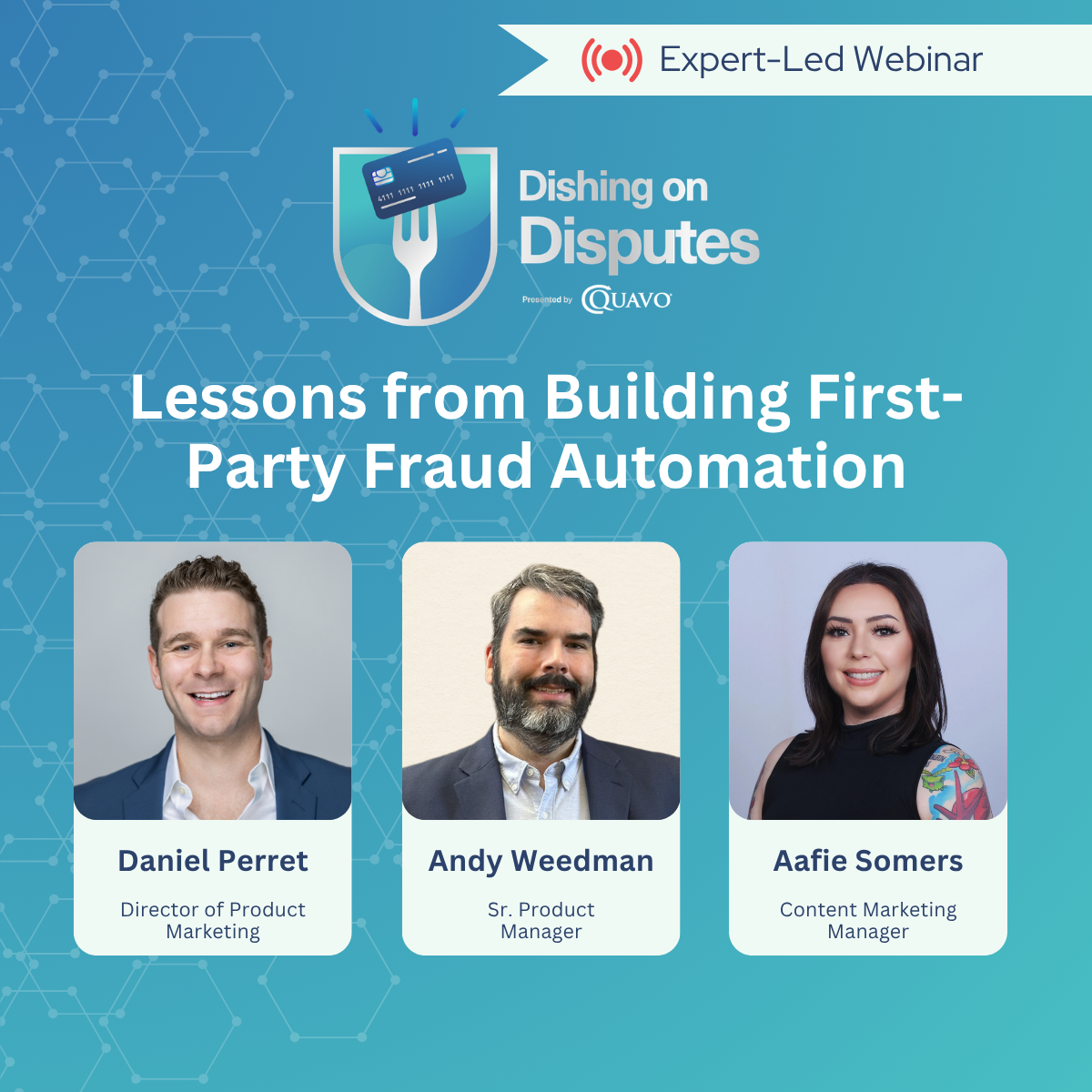
Dishing On Disputes | Lessons from Building First-Party Fraud Automation
Building a fraud-fighting AI starts investigators, not with models. In this session, we walk through how Quavo designed and trained an AI specifically to tackle first-party fraud by first identifying where automation would drive the most impact. For Quavo, that meant amplifying the investigation process rather than replacing it.
Hosted by Director of Product Marketing, Daniel Perret, and Sr. Product Manager, Andy Weedman, the two will break down how our team partnered directly with investigators to deconstruct real investigation workflows, from evidence gathering and decision logic to compliance considerations, and translate that human expertise into an AI capable of executing those steps at scale. This investigative framework became the foundation of our training approach, allowing the AI to mirror how experienced analysts think, not just what rules they follow.
Attendees will also get an honest look at the challenges we encountered along the way, including early training missteps, edge-case complexity, and the guardrails required to maintain trust, accuracy, and regulatory alignment. We’ll close by sharing how we continuously refine and retrain the AI as fraud patterns evolve, and what other fraud teams should watch for when building or evaluating AI-driven investigation tools.
*This is a recording of a prior live webinar.